
This post is part of the series in response to Dunbar’s 2012 Australian seminars. See index.
New puppy homes need to have a long term confinement area set up ready for their puppy’s arrival. The idea is that, by using a pen setup in this way, the puppy will self-toilet-train and self-chew-toy-train. It also helps to teach the puppy to be alone. Long term confinement areas are designed so puppies learn where to pee and where to chew, and how to be alone. Basically, a pen like this allows a puppy to make correct choices, and so be successful in achieving appropriate behaviours.
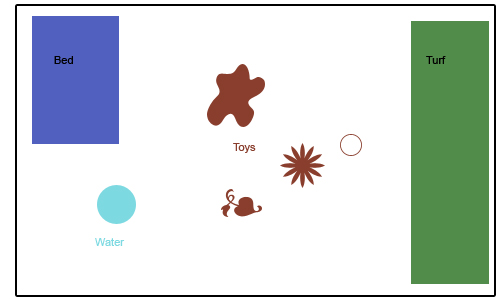
Dunbar advocates for puppy pens to be set up with the bed far away from a toileting areas, as puppies are naturally inclined to toilet away from their sleeping area.
This pen has several features:
- The edges of the bed can (and should!) be taped down to prevent the puppy chewing the bed.
- Kongs should be used to distribute food in the middle. The Kong could be tied to the edge, to prevent it entering the toilet area, or you could raise the toilet area in a litter box so the Kong can’t roll in there.
- The toilet area should be turf and as far from the bedroom as possible, as puppies naturally want to eliminate away from their bed.
- The toilet area should have faeces removed as soon as possible, but the urine should be left so that the odour attracts puppies to return to eliminate in the same spot.
- The water is near the sleeping area.
- There should be plenty of Kongs! Puppies should only be fed from Kongs.
Regarding food toys, Dunbar advocates puppies being fed exclusively from a food toy. Chewing a food toy becomes a ‘good habit’, and good habits are as hard to break as bad habits. Furthermore, the puppy will begin to think, “Why would I chew the furniture? I can’t get food out of it!”
The long term confinement area is not just for puppy buyers, but also for breeders. Breeders should have this area set up to teach puppies good habits from the get go. Here is a video showing how I set up my puppy pen at home. (Dunbar would criticise my lack of Kongs!)
It’s important that the new puppy owner has it all planned. There can not be the opportunity for the puppy to make mistakes and begin to develop ‘bad’ habits that may result in them entering the shelter at a later date.
I’m a little curious as what that grass you are using is. Are they artificial or something else? If you don’t mind, can you share with me how you’ve placed the grass and the papers so as to find out the most efficient way to place them. I only paper trained Peanuts.
And what about the poop? If there are tiny bits left, do you wash the artificial grass immediately?
Had Kongs been cheap where I live, I’d get them in a heartbeat. Unfortunately, the smallest Kong costs 5 times a regular latex toy made for dogs.
Huggies and Cheese,
Haopee
By the way, GREAT ARTICLE. Have you heard of Leernberg?
The turf I use is artificial grass, but Dunbar advocates using real grass. Poos are normally easy to wipe off of the grass – it’s only sloppy poos that are a problem. I wash the turf after about a week or so, and I have about 5 pieces of turf cut and ready to go so the pups never go without grass.
The grass is placed ontop of newspaper with papertowel sandwiched between – but with my last litter, I just used turf with nothing underneath. I haven’t decided the best way to do it yet!
Kongs are expensive, but they’re supposed to be durable and last longer than a typical toy.
I have heard of Leerberg and have read a lot of his stuff, but I generally don’t agree with him. He seems into dominance and harsh punishments which I don’t advocate.
I’m a big believer in using an x-pen for puppies. it gives them a small, safe territory to explore while keeping them out of trouble.
Although it’s not possible for every household, it’s ideal to not put a potty area in the confinement area at all. Of course that means you’ll need to be available to take an 8 week puppy out every 2-3 hours. I was lucky my boss gave me permission to bring Honey to work during house training.
Hey Pamela. In the past, I have always encouraged owners to not allow their puppies to toilet inside at all, and to use a crate when they could not watch their puppy. However, Dunbar would argue that new owners are pretty bad at toilet training puppies and we want to set the puppy up for success. A puppy pen, set up like this, means that the puppy gets ‘toilet trained’ (develops a preference for peeing on turf) with minimal effort on the owner’s part. The resounding message from Dunbar would be that your average pet owner needs a lot of help!
For my own puppies (i.e. ones I keep), I crate them inside from 8 weeks, and they are only supervised inside, and unsupervised time outside. I’m pretty good at this. 😉 But your typical new puppy owner doesn’t really understand what ‘supervise’ is, and doesn’t always use crates in the best way.
And, for a breeder, it’s close to impossible to manage the toileting habits of 3+ puppies to ensure they are peeing outside and not inside… When one goes, you celebrate, and wait for the next, and the next… Then it time for the first one to go again! I definitely think this is the best set up for breeders, but is probably not for highly dog-savvy owners. (But for new puppy people, yes!)
Pingback: Bringing Home a New Puppy (Dunbar) | Some Thoughts About Dogs
On weekdays I wake up at seven and leave at eight and am back at 3:30 so how do I do my puppies food schedual (and can’t affored someone to come in an give them food) could I give them food when I wake up and leave them food befor I go?
Hi Nora. It depends on the age of your puppy in regard to how many meals they would need, but I would give them one as you leave (at 8am), one as soon as you get home (3:30pm) and 1-2 other meals during the day, depending on their age. Some people will get their mum or dad to babysit for days where the puppy may otherwise have to go without lunch – lots of people are pretty keen to babysit puppies!
Hi,
I brought home a westie-scottie mix puppy home and been trying to toilet train. Due to the restrictions in a rental home, I would like to paper train so that she can go to the toilet when there is no opportunities to go out.
I first brought her home at 8 weeks and now she is 13 weeks. I have enclosed her in a room and set up similar to what you have done. I faced with a couple of problems enclosing in her room. The room is pretty big and I am not sure if I am giving her too much space. Most of the times she pees and poo on place I want her to toilet but there are times she would pee somewhere else.
The other problem I have is that the room is far from the living area (where all the activities happen). When I am home, I let her out with me and do as much supervision as possible. I would also do what any new puppy owner would do. I ask my puppy to go to the toilet every 2-3 hours. But sometimes, I missed out on asking her to go and she would it on the carpet flooring. There are also times when she goes to her toilet area herself without any supervision. But there are the horrible days where she would just pee everywhere. I’m not sure if she gets it.
Should I enclosed her till she is toilet trained? And how long should I do that?
I’m not sure if I have done right or whether this is normal. I would really appreciate some advice on this.
Hi Yilin,
It sounds like you may be giving your puppy a bit too much freedom at the moment. I would be taking the puppy to toilet every 1 hour and anytime she changes activities (e.g. wakes up, finishes eating, has a drink, etc). If the puppy doesn’t toilet, I would either a) confine to their long term confinement area, or b) confine to a crate. Not until the puppy has gone to the toilet in the right spot would I then let the puppy out to be social again.
I hope this is helpful.
Hello, i am in the process of obtaining a puppy of my own. I will be away from 620am-430 pm. the idea of a long term confinement cage is really appealing, though i have a couple concerns. I don’t believe anyone will be comiong throughout the day to see my pup. Is that cruel? and will it harm my puppy? also, im concerned as to how the pup will know to toilet on the turf. i realize that it is their instinct to not go within their sleeping quarters.
Thanks!!
Hi Cole,
Congratulations on your new puppy and it’s great that you’re already putting thought into raising your puppy.
Puppies, until they are about 12 weeks old, need meals 3 times a day. It would be great if the puppy could get lunch, but we also realise it’s not always possible.
As long as your puppy is getting plenty of family and socialising time when you are home (that includes going out of the house to meet new people and environments), your schedule should not hurt your puppy.
Some puppies will naturally go on the turf (especially if kept in a clean environment as a puppy), but sometimes you have to use the methods shown here to increase their desire to toilet on the turf: http://leemakennels.com/blog/puppies/puppies-the-fifth-week/#more-1874
Best of luck with your puppy.
Hello, we are intrigued by your long term confinement setup. Just brought home our 9-week-old border collie-lab mix.
If I’m understanding the diagram, a crate is not used? Or could an open-door crate be used in lieu of a bed?
Also, I’d like to know the area size you feel is ideal. Our puppy weighs 13 lbs. at present. Mom is a border collie, dad is a lab – we are thinking she will end up at around 60lbs.
What size sod area? Should it be watered? How often should the sod be replaced?
On another subject, is she the right age to introduce collar and leash?
Thanks,
Karen
Hi Karen,
Thanks for reading and commenting. 🙂
You can use whatever bed you’d like – an open doored crate is fine, and what I use for myself (the video shows that).
I would say to make the area as big as practical, as long as the dog is using the toilet area. I have had puppies before who were not-so-good at using the turf to toilet, so I made the area very small, so they got in the habit of using the turf, and then gradually increased the size overtime.
When you’re talking about turf (I guess that’s what you mean by ‘sod area?’), you can use synthetic turf (like I do) and wash it every few days in the washing machine. Ian Dunbar, however, actually suggests you buy strips of real grass, and alternate them inside. So have one outside (that you water and keep alive) and swap it over with the one inside. I’ve never used real turf because of convenience factors, so I can’t give much advice there.
They can wear a collar whenever you’d like, and as long as you’re using gentle methods for teaching leash walking, you can introduce that anytime from 6 weeks, too.
Hope that helps. All the best with your puppy.
Hello Leema..
I was thinking about getting an old english mastiif .. Unfortunately i can’t keep it inside my home ..
I can have a 3X3 m cage in the backyard.. Would that be sufficent for him to stay most of the 24 hours of the day?
However – as i can’t get it inside home- i was wondering what is the least time that i should stay with him per day ( both as a puppy and after growing up) ??
I am really confused as i am afraid of torturing him by leaving him alone for long time .. And i won’t be able to get another dog to stay with him before 6 months ..
Thank u
Hi Nagui,
It sounds like you’re a bit too busy for a puppy or dog at the moment. If you were to get a new dog or puppy, you need to spend a lot of time settling them in, training, and socialising – and if you don’t have more than an hour free each day, then it’s very unlikely that you will be able to raise a train and well-balanced and happy dog.
Maybe you should reassess your situation in a few months time.
Kind regards,
Tegan
Sorry the area of the cage is 7 X 6 meters 🙂
I’ve been raising a pair of golden retriever pups since they were 6 days old because they can’t drink mom’s milk; they’re now a month old and very cute, which is probably why I don’t balk at keeping an eye on them throughout the day (I’ve taken to sitting next to their pen w a camera for keepsake & book for when they’re asleep.) I still feel they’re at heavy disadvantage even though the vet says they’re healthy. I would like to do everything so they grow up healthy, happy and well behaved. We’ve made them a pen roughly 3.5 feet all around using the white hard plastic floorings for dog pens and plastic covered fence that they can’t chew. There’s a metal tray beneath the toilet area wc is about a third of the pen, and they do their business there. But sometimes they get up, take a step and pee on their play/sleep area wc is covered w a towel, also when we get up in the morning one or both of them would have peed on their bedding. Will adopting your pen idea solve this or arw they too young for it?
Hi Kay,
You didn’t say how old your puppies are, but from about 3 weeks I have people using a small toileting area semi-reliably.
I too sometimes have a problem with puppies getting up and peeing straight after walking from their bed. I find it helps to have a crate for them to sleep in, and only have bedding in that crate. This means that, at the very least, they avoid toileting on (and so prevent developing a preference for toileting on) bedding.
Sometimes I set up the puppy pen so it’s much smaller, and so their crates practically open onto the toileting area. This helps to ‘make them’ toilet on the toileting area and develop a preference for going on it, and then I increase the size of the play area.
I hope that helps.
They just turned one month, which males me so happy and maybe a little less anxious. Thank you very much for your suggestion, I’ll give it a try and let you know 🙂
Hi there!
We just got an 8 week year old pup (mix lab beagle and pug). She does very well in her crate at night which we put in our bedroom. She wakes up maybe twice a night to potty.
But the problem is during the day! We have a play pen in the living room which we have been putting her in every now and then but she still whines alot despite us being right there. We have all sorts of toys in there (kongs, chew toys, water, bed, etc) and she will play with them for 10 mins before wanting to get out and be with us.
We dont pay any attention until she keeps quiet and then we give her a treat for behaving and she will play with her toys again for 5 mins before proceeding to whine. After 20 mins of repeating the process she will just fall asleep.
We are trying to get her used to being alone and independent. Are we on the right track? We have tried leaving our house for 5 mins, then 10 mins then 15 mins and she howls and tries to get out of the pen once she realises we are gone.
I dont think she has issues with the pen she just doesnt like to be separated from us.
Appreciate your reply!
Hi Ching,
I’d try leaving food toys and treats in the pen, but removing her before she has a chance to get bored with them or finish them and start crying.
This may mean that you start by leaving her in there for only a few minutes at a time, and build up.
Another thing you can try is to leave the puppy out of the pen, but let the pup see you put delicious things nto the pen… In that way they really want to be in the pen, because it’s away from you.
Another option is to set up the pen so the puppy can’t see you anymore.
OR: Just ditch the pen idea altogether, and use a crate when you can’t supervise.
Hi Leema,
I have been trying to follow Ian Dumbar’s methods of long term and short term confinement which correlates with your blog here. It has only been 4 days since I’ve had my westie, Rocco, but it hasnt been easy trying to keep him in confinement.
We got Rocco from a house breeder (who was registered) he was the last one to go out of the litter. He came from a house where he was allowed to run free around the whole house with his littermates and eliminate on newspapers. He is currently 9.5 weeks old.
When we got him home, we took him to the long term confinement area in our laundry next to our kitchen and stayed with him in there. He immediately saw our baby gate door and began whining and crying jumping at the door. His crate is also in the long term confinement with the door open and water bowl inside. When he is tired, he cries and whines for a little while before sleeping straight on the floor in the corners of the room. We have tried to place him in the crate while he’s asleep and he seemed ok. At night we have had him in the crate with us in the bedroom. He would cry and whine til he is asleep. At first I had to take him out every 2 hours during the night for potty. Now it’s getting to every 3 hours at night. But as soon as we place him in the laundry in the morning, he cries, barks and whines for a long time. We try not to attend to him when he is making loud noises and only when he is quiet. He still doesn’t enjoy any confinement. When we have him playing in the kitchen with us, we have chairs as barricades and he still cries and tries to jump over the chairs while we are in there with him. Even to any closed doors, he scratches and whines at it.
Should I keep to this routine until he is used to it? I saw the above post and he whines and cries when I am in the kitchen next to him non stop. After his naps in the long term confinement area, I take him to potty but he only pees and doesn’t poo. Then when I am playing with him, he poos but only in the kitchen, never in his litterbox in the long term confinement.I’ve tried to catch him to take him outside but he just stares at me until I wait for 5 minutes and take him back in. So pretty much, we have problems with confinement and problems with poo training. He is also not interested in kong toys or food chew toys.
Sorry for the long post. Desperately need help and advice. Would really appreciate it.
Regards,
Tina
Hi Tina,
If your breeder has trained your puppy to toilet on newspapers, you are probably best to use them as at least part of the toileting area in his confinement area.
It sounds like you’ve trained your puppy to poo in the kitchen, and if that’s the only place he has pooed at your house, he is likely in a habit now that will be hard to break.
If your puppy is reasonably good in the crate, I would be inclined to move him into a crate and scrap the whole long term confinement area idea – unless your puppy is going to be routinely left for periods of time of 4 hours or more.
Hope that helps.
Thank you so much for the reply, Leema!
I will try laying newspaper outside and inside, but I have seen him tear the newspapers during the times he has cried. He is only ok in the crate and long term confinement when he is due for a nap which is about every 1.5 hours but when he is up and I’ve tried to play with him for half an hour then go and do something or have to go to work, he gets very upset. He also gets upset about being in the crate right next to me when I am doing work in the house or can’t mentally attend to him. Right now, I’ve been trying to only keep him in the long term confinement and play with him in there so he doesn’t make any more mistakes in the kitchen. The dog trainer I have talked briefly to has mentioned to put him back in the crate if he doesnt poo then take him outaide again. But what if he pees outside in the right spot, I still have to reward him. I have even picked some of his poo to put on the grass outside so he knows to poo there but he still won’t.
If I keep him confined every day with toys to chew on, will he eventually get used to it? As I will start full time work in 3 more weeks and am very afraid that he still will not adjust. I certainly cannot keep him in the crate for longer than 3 hours and I cannot have him running around the whole house when I’m gone. I have to keep telling myself it has only been 5 days since we’ve had him and that he will get used to it, but I am not sure!! Thank you so much for replying, hope to hear back! 🙂
I got a 10 week old puppy(chihuahua and dachshund mix) and I keep her in a confinement area(a gated pen) with her bed, chew toys, and a pee pad for her to go potty. I keep her in there during nights and usually during the day too. I would take her out sometimes to play and cuddle with her and put her back in. She would then start whining and eventually stop because I’m in the room with her. But when I go out of her sight, even just down to the kitchen to cook, she cries and barks for so long for me to ignore. She now even climbs out of her pen when I’m out of her sight for even 5 minutes. What can I do to help her? I really try not to give her attention when she’s too loud but it’s so hard to ignore.
Hi,
We are getting an 8 week old golden retriever puppy in 3 weeks and have been reading Ian Dunbar’s book in preparation of her arrival. My question with the long -term confinement area is this … does having the “grass” toileting area in the house simply condition the dog that it is ok to go to the potty inside?
Also, someone will be home with her for the entire first month so in your opinion, is it necessary to have the indoor toileting area if we are consistent with taking her out every couple of hours?
Thanks!
Hi Katie,
My preference is to have a puppy never toilet inside, so they are always supervised inside, and are taken out every hour or so and rewarded for going outside, etc. This is ‘the best way’ to toilet train a puppy. However, in reality, people are quite sucky at doing this, and dogs get into bad habits. A puppy should never be allowed to have an ‘accident’, and the long term confinement prevents accidents.
Further, as a breeder who could have numerous puppies running around at once, I use this method because I can’t effective supervise three or more pups.
I hope that helps,
Tegan
Tegan,
Thanks so much … you confirmed my opinion that it is best to not allow her to toilet inside as long as we are diligen about taking her out ( hopefully we won’t be too sucky with that 🙂 ) ! Thanks again.
Katie
We are also planning on following Ian Dunbar’s recommendations for a new pup, however the only part I haven’t figured out is overnight. I am not keen on training the pup to ‘go’ indoors, even in a designated spot, but what do you do at night? Should we crate the pup at night and wait to hear him cry to be let out to toilet, or leave him in the long-term confinement area with the crate open and a potty area for him to use? Any advice would be appreciated, thank you.
PS Fantastic website, thank you.
PPS I should have said “or leave him in the long-term confinement area with the crate open and a potty area for him to use so we don’t need to get up for him”!
I have a 13 week old chihuahua and I’ve tried potty training and crate training and all she does is whine in the crate and sometimes goes on the potty pad. I’ve started putting her in a small downstairs bathroom with a baby gate up so she can see us but she just whines. She’s got toys, a bed, food, water, and potty pad. What do I do. I live in a apartment so grass is limited for outside potty places. Please help.
Thank you.
We are getting our puppy in July and have been recommended by our breeder to use Ian Dunbars methods. We will be gone for ~6 hrs each day without anyone being able to come home for lunch so I believe the long-term confinement is the best way to go for our pup. My question is can you/how do you eventually transition away from the indoor potty? I am fine with it in the beginning as the puppy is learning but I dont want to have it around forever.
Hi,
I’m getting a 7 and 5 day old puppy in 3 weeks, I am confused with short-term and long-term confinement. For the first month I will be home mostly all the time, but after that I will be gone for 6 hours. During this time I am planning on putting my puppy in a long-term confinement, I will also try my best to get a walker to come in the middle of the 6 hours and walk it. Should I always have a potty area in my long-term confinement area and doesn’t that teach the puppy to pee inside. Also when I am home should I have my puppy in the crate? If so after I take it outside and on a walk and play with it for a little should I put it back in the crate and repeat this for a few weeks or? If I don’t put a soil area in my long term confinement area after the first month when I have to work again will it soil before I walk it. I’m sorry for all the confusing questions, I am just concerned about my puppy soiling in the house and want to know exactly what to do.
I have a 19 week old Shih Tzu maltese pup I’ve has almost 3 weeks. I have a large ex pen (3feet x 6 x 3) and wonder how long I should keep him in the pen at a time. He is pretty good about using the wee wee pads (kept out of the pen), has not had an accident in the pen, and goes almost 10 hours in the crate overnight without accidents. I started giving him a bit too much freedom and was not regulating potty time, food time, play time, quiet time etc enough but worry that now I’m keepng him in too long (90 min in, 1 hour out). He started out liking his pen but now whines when he has to go in.
I hope you’ve seen the newest episodes of Shark Tank because this website sells real grass! I think it will be perfect for breeders needing the indoor potty grass and there isn’t any sod in stock at Lowe’s or Home Depot.
http://freshpatch.com
* I have no affiliation with this company, I just thought it was awesome when I saw it.
Hi,
I have been doing a lot of reading in preparation for our cockapoo puppy we will be getting in the Spring. I am a little confused about when to use long-term confinement vs. the crate. My plan is to crate at night or during the day if we are going to be gone for more than an hour or two the from the house. Otherwise, I was planning on long-term confinement without a potty area if we are home, assuming we will offer potty trips every hour, and WITH a potty area while I am at work from 8-2. Does this sound reasonable/right? I am hoping that this doesn’t confuse the puppy and make it think it is ok to go in the house.
Hello,
I live in an apartment that backs onto a two level garden. We currently have a spoodle who is 3.5 yrs old and toilet and house trained.
We originally trained our new puppy a groodle (he is 9wks old and we are 5 days in) to pee outside but we are renting and can’t fence the area or install a doggy door and need a solution for when we go to work.
Our working day is 7.45am-6pm and we go back to work full time in 7days so want to start the training asap.
My biggest concern is toilet training, whimpering and the effect of the spoodle.
We have a sunroom area that backs onto the garden (when we open the doors-not fenced) I was going to put him in here?
Do I put the spoodle in there too or seperate them?
The area is approx 20sqm
Should I purchase a crate to go in the area?
Do I put the spoodle in the area also?
Do I start inside toilet training?
Hello! Thanks for the great information! I am curious though, why is it so important for puppies to only eat from kongs? I am getting my first puppy (as a young adult with no parental help) in a few weeks, I have been reading your articles and following it to a T! Anyways, just curious so I have all the information before my new baby gets here!
Thanks,
Taylor
Hi Taylor,
Here’s my post on the positives of kongs: http://leemakennels.com/blog/puppies/praise-kongs/
Hi, I am bringing home 2 Maltese puppies that are about 5 months old. The current owner has not toilet trained them. I work so am out of the house from 8:30 -5:30. I am working out if it would be best to keep them confined in my bathroom (it’s quite big) or to keep them in the backyard ( concreted and fenced with a patio) while I am out so they have more space to run? What would be best for puppies this age and breed?